
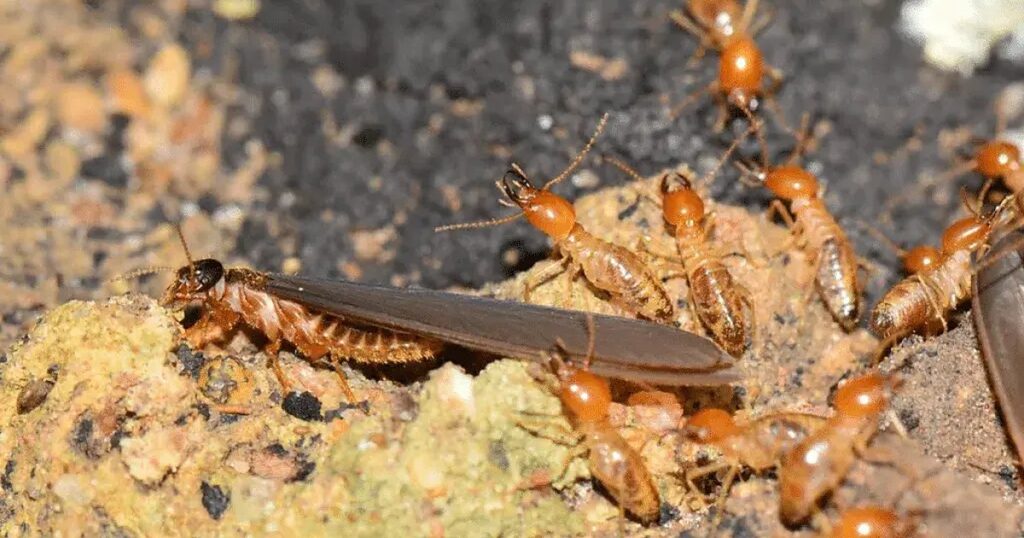
One warm morning in March you walk into the kitchen and the window is covered in winged bugs. Hundreds of them. By noon they are gone, and all that is left is a scatter of tiny wings on the sill.
You just watched a termite swarm. It is the one time all year that termites make themselves easy to see. Termites cost U.S. homeowners more than $5 billion a year, and this is your early warning.
Here is what the swarm means, and what to do in the next hour.
When do termites swarm in Texas?
Termite swarm season in Texas runs from late winter into summer. The exact weeks depend on which termite you have.
Native subterranean termites go first. They usually swarm from February through May. They fly in the middle of the morning. The trigger is usually a good rain a day or two before, plus warm damp air.
Formosan subterranean termites come later, around April through July. These fly at dusk and after dark. They chase light, so they pile up at porch lamps and lit windows.
Drywood termites keep their own calendar. They tend to swarm in late summer and fall.
So a swarm in March and a swarm in June are telling you two different things. Note the date and the time of day. That detail helps us more than you would guess.
How long does a swarm last?
Not long. A single flight is usually over in half an hour.
That is part of the problem. The bugs vanish, the room looks normal again, and the whole thing starts to feel like it was no big deal.
One colony can also swarm more than once. You may get a flight this week and another one two weeks later, on the next warm day after rain. And a colony that swarmed this spring will swarm again next spring, in the same window, from the same spot. Termite swarm season in Texas is an annual appointment until someone treats the colony.
A swarm inside the house is the bad version
Termite swarmers are weak fliers. They do not travel far, and a light breeze pushes them around.
That is why the location matters so much. Swarmers outside in the yard may have come from a stump, a fence line, or a neighbor’s tree. Swarmers inside your house almost always came from inside or under your house.
If they came out of a wall, a door frame, a floor joint, or a bathroom vent, the colony is in the structure. Not near it. In it.
Swarmers do not eat your house
This part surprises people. The winged termites you are looking at will not chew a single board.
A termite colony splits the work. Workers eat wood and cause every dollar of damage. Soldiers guard them. Swarmers have one job, which is to fly out, pair off, and start a new colony somewhere else. They have no mouthparts for wood. They do not bite you, sting you, or carry disease.
So the swarm itself is harmless. What it proves is not.
A colony has to grow up before it makes swarmers. That takes years, usually three to five. Seeing swarmers means the colony under your slab is mature and big enough to spare a few thousand bodies. It has been eating for a long time already.
Flying termites or flying ants?
Ants swarm in spring too, and the two get mixed up constantly. Three tells separate them, and you can see all three with your phone camera zoomed in.
- A termite is one straight tube from head to tail. An ant is pinched in the middle like a wasp.
- A termite has four wings of equal length, all longer than its body. An ant’s front wings are clearly longer than its back wings.
- A termite’s antennae are straight, like tiny strings of beads. An ant’s have a sharp elbow bend.
Color helps a little. Flying termites in South Texas are usually pale tan to dark brown with smoky gray wings.
If you are not sure, do not guess. Save one in a zip bag and we will tell you what it is at no charge.
What to do in the first hour
Resist the urge to grab a can of bug spray. Here is what actually helps.
- Do not spray the swarmers. Killing them changes nothing and can scatter the colony deeper.
- Vacuum them up. That is the fastest way to clear the room.
- Save five or six in a bag or a jar. Add a drop of rubbing alcohol if you have it.
- Photograph the spot they came out of. That crack is the most useful clue in the house.
- Write down the date and the time of day.
- Leave the wings where they fell until someone sees them.
Then call. A swarm is a same-day call, not a next-month call.
The wings on the windowsill
Swarmers shed their wings on purpose. Once a pair lands and pairs off, the wings come off and get left behind.
That is why you find little piles of them on window sills. Bathtubs and light fixtures are the other usual spots. The wings are small and clear. Most people mistake them for fish scales.
Discarded wings inside your home are one of the strongest signs there is. You may never see a single bug. The wings alone are enough to book a termite inspection, and ours is free.
Why South Texas gets the worst of it
Termites want warmth and moisture, and the Gulf Coast hands them both.
Our winters are short, so colonies stay active while colonies up north sit still. Humidity keeps soil damp most of the year. Slab-on-grade homes put framing lumber close to that damp soil. Rain in spring triggers the flights.
Formosan termites make it worse. They build the biggest colonies of any termite in the country, and the Gulf Coast is their territory. A mature Formosan colony can hold millions of workers.
For homeowners looking up termite swarmers in Victoria, TX, that is the short version of why this keeps happening here every single spring.
Cutting your odds before next spring
You cannot stop a swarm. You can make your house the least appealing stop on the block.
- Fix leaks fast, especially under sinks and around water heaters
- Point downspouts and AC drain lines away from the slab
- Keep mulch two inches below the slab edge and a few inches off the siding
- Move firewood off the ground and away from the wall
- Pull out old stumps and buried scrap lumber
- Keep an air gap between soil and any wood that touches the house
- Trim shrubs back so the foundation stays dry and visible
Our guide on how to prevent termite damage in your home goes deeper on each one.
Treatment is the other half. Subterranean colonies get a liquid barrier in the soil around the slab. Drywood termites get treated in the wood itself. New builds get the soil treated before the concrete goes down. You can compare the methods on our termite treatment page.
Saw a swarm? Call today
Termite swarm season in Texas gives you one clear warning a year. Most people sweep it up and forget it until the floor goes soft.
Bugmobiles has worked South Texas homes since 1954. Our Google rating sits at 4.9 stars across 1,353 reviews. The inspection is free, and a tech will call you back the same day.
Call (361) 575-6401 or (800) 626-9329. Bring the bag of bugs. We will tell you what you are dealing with.